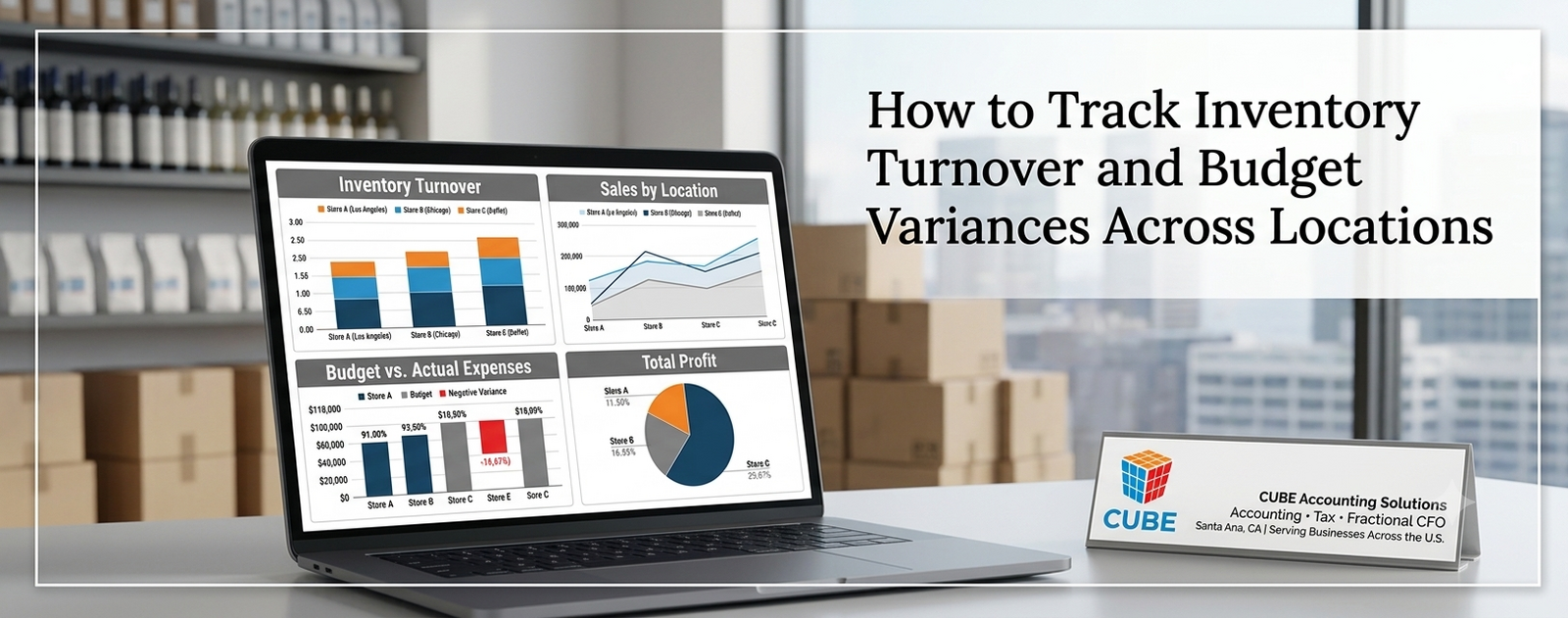
Managing several business locations can make financial tracking harder. Each location may have different sales, inventory levels, expenses, and customer demand. Without a clear way to compare them, it can be difficult to know which locations are performing as expected and where problems may be developing.
This is where SMB budgeting and variance reporting can help. By tracking inventory turnover and comparing actual results with the budget, business owners can see changes early and take action before small issues become larger financial problems.
What Is Inventory Turnover?
Inventory turnover shows how quickly a business sells and replaces its inventory during a specific period.
A high turnover rate can mean products are selling quickly. A low rate may mean inventory is sitting too long. However, the right turnover level depends on the type of business and the products it sells.
For businesses with multiple locations, tracking turnover by location is especially useful. One store may be selling inventory quickly while another may have too much stock sitting on shelves.
Why Track Inventory Turnover by Location?
Looking only at total company inventory can hide important differences.
For example, imagine a business has three locations. The company may have healthy overall sales, but one location could have slow-moving inventory while another is frequently running out of popular products.
Tracking each location separately can help management identify:
-
Slow-moving inventory
-
Products that sell quickly
-
Locations carrying too much stock
-
Locations facing frequent shortages
-
Changes in customer demand
-
Differences in purchasing patterns
This information can help managers make better purchasing and inventory decisions.
What Are Budget Variances?
A budget variance is the difference between what a business expected to happen and what actually happened.
For example, if a location budgeted $20,000 for monthly operating expenses but actually spent $23,000, the variance is $3,000 above budget.
Not every variance is a problem. A higher expense could be caused by a planned purchase, seasonal activity, or a one-time event. The important part is understanding why the difference occurred.
This is a key purpose of SMB budgeting and variance reporting.
Compare Budget and Actual Results by Location
When a business has several locations, company-wide numbers may not provide enough detail.
Instead, management can compare each location's:
This makes it easier to see where results are different from expectations.
For example, if Location A is consistently 5% below its sales budget while Location B is 10% above budget, management can investigate what is driving the difference.
Connect Inventory Turnover With Budget Variances
Inventory and budgeting should not be reviewed as completely separate areas.
Suppose a location has lower-than-expected sales and rising inventory. That combination may deserve closer attention. The business may be purchasing more products than customers are buying.
On the other hand, a location with strong sales and very high inventory turnover may need more frequent purchasing to avoid running out of products.
By reviewing these metrics together, SMB budgeting and variance reporting can provide more useful information than looking at either metric alone.
Use Simple Monthly Reporting
Businesses do not always need complicated dashboards to start tracking these numbers.
A simple monthly report can show each location's budget, actual results, variance, inventory balance, and inventory turnover.
Management can then ask a few basic questions:
-
What changed?
-
Why did it change?
-
Is the change temporary or ongoing?
-
Does the budget need to be adjusted?
-
Does the location need a different inventory strategy?
These questions can turn financial reporting into a useful management tool.
Watch for Repeated Variances
One unusual variance may not mean much. Repeated variances are more important.
For example, if one location spends more than its budget every month, management should investigate the reason. The original budget may be unrealistic, or the location may have an expense or operational issue that needs attention.
The same idea applies to inventory turnover. If one location consistently has much slower turnover than similar locations, it may be worth reviewing purchasing, pricing, product mix, or customer demand.
Use Cash Flow Forecasting Alongside Inventory Tracking
Inventory purchases can have a direct effect on cash.
A business may have strong sales but still experience cash pressure if too much money is tied up in inventory. This is why cash flow forecasting for small business can complement inventory and budget reporting.
By looking at expected cash inflows, planned purchases, and upcoming expenses, management can better understand how inventory decisions may affect available cash.
Make Location Reporting Consistent
Comparing locations only works when the numbers are measured consistently.
Each location should use the same basic definitions for revenue, expenses, inventory, and budget categories. Reporting periods should also be consistent.
Clear reporting rules reduce confusion and make it easier to compare one location with another.
How Cube Accounting Solutions Can Help
Cube Accounting Solutions helps businesses organize financial information and use reporting to support better financial decisions.
For businesses managing multiple locations, accounting and financial reporting can help bring together sales, expenses, inventory information, and budget results. Cube Accounting Solutions can also provide Fractional CFO services for small business, including budgeting, variance analysis, cash flow planning, and management reporting.
The goal is not simply to produce another report. It is to give business owners information they can understand and use.
Final Thoughts
Tracking inventory turnover and budget variances by location gives business owners a clearer picture of what is happening across the company.
SMB budgeting and variance reporting can help identify unusual spending, changing inventory patterns, and differences between locations. When these reports are reviewed consistently, management can investigate problems earlier and make more informed decisions.
The process does not have to be complicated. Start with a few important metrics, keep reporting consistent, and focus on understanding why the numbers changed.