Typhoid fever still affects an estimated 9 million people each year, according to the World Health Organization, with the heaviest burden in South Asia and sub-Saharan Africa. Yet in many clinics the diagnosis rests on a fever that won't settle and a Widal test that is notoriously hard to interpret. The result is a familiar pattern: patients treated for typhoid they don't have, and real cases missed or treated late.
A Salmonella Typhi antigen rapid test kit offers a different route. It works on a stool sample, gives a result in under 20 minutes, and looks for the organism itself rather than the body's antibody response. This article is written for laboratory managers, clinic teams and procurement staff in endemic regions who are deciding where antigen testing fits in their medical laboratory diagnostics workflow, and how to plan stock for it.
Why Typhoid Is Difficult to Diagnose
Enteric fever is caused by Salmonella enterica serovar Typhi (typhoid) and serovars Paratyphi A, B and C (paratyphoid). It spreads through contaminated food and water, and its early symptoms are frustratingly non-specific: sustained fever, headache, abdominal pain, fatigue, and either constipation or diarrhoea.
In regions where malaria, dengue and other febrile illnesses circulate at the same time, clinical signs alone cannot separate these conditions. Laboratory confirmation matters, but the traditional options each have drawbacks. Blood culture is the reference method, yet it takes several days, needs trained staff and incubation equipment, and its sensitivity drops sharply when patients have already taken antibiotics. The Widal test is cheap and widely available, but cross-reacting antibodies, previous infection and vaccination all produce false positives, especially from a single sample.
Misdiagnosis carries real costs. Over-reliance on the Widal test leads to unnecessary antibiotic courses, which add to resistance pressure, while missed cases risk complications such as intestinal perforation and continued spread in the community. Those gaps explain why rapid tests have become part of typhoid workups in many settings.
How Does a Stool Antigen Test Detect Typhoid?
A Salmonella antigen test is a stool diagnostic test that detects antigens released by the bacteria in the gut and shed in faeces. Because it targets the pathogen directly, a positive result points to the organism being present, rather than to an antibody response that may linger from past exposure.
The test uses lateral flow immunochromatography. The extracted stool sample travels along a membrane coated with antibodies against Salmonella antigens. If antigen is present, it is captured with coloured gold-conjugate particles at the test line, producing a visible band beside the control line.
An important design choice is coverage. Some products detect Typhi alone, while others also detect Paratyphi serovars. Since Paratyphi A causes a significant share of enteric fever in parts of Asia, a test that covers both reduces the risk of missing paratyphoid cases that present identically.
Antigen Testing Compared With Culture, Widal and Antibody Tests
Choosing a Typhoid Rapid Test Kit starts with understanding what each type actually measures.
Antibody-based rapid tests detect IgM, IgG or both against Salmonella antigens. They are quick and use blood, but antibodies take time to rise and can persist after recovery, which makes interpretation difficult in endemic populations where many people have been exposed before.
Antigen tests avoid that problem by detecting the bacteria. They also need no blood draw, which suits children and community screening. Their limitation is the opposite of antibody tests: shedding can be intermittent, so a negative result does not completely rule out infection, and a positive result can occasionally reflect a chronic carrier rather than acute illness.
Culture remains essential for one reason no rapid test can replace: antibiotic susceptibility testing. With drug-resistant typhoid strains spreading in several countries, laboratories need isolates to guide treatment and track resistance. In practice, a salmonella rapid test kit works best as a fast front-line tool that supports early clinical decisions, while culture confirms the organism and its resistance profile wherever facilities allow.
Using the Test in the Lab and at the Point of Care
Stool antigen tests are well suited to Point-of-Care Diagnostics because they need no centrifuge, incubator or reader. The same kit can run in a hospital laboratory, a primary health centre, or a field station during an outbreak investigation.
Sample Collection and Reading
Workflow details vary by manufacturer, so the instructions for use always come first. In general, the collection stick is pushed into several areas of a fresh stool sample rather than scooped, then screwed into the buffer tube and shaken to release antigens. A few drops of the extract go into the sample well, and the result is read within the time window in the IFU, typically 15 to 20 minutes. A line at both C and T indicates a positive result; C alone is negative; no C line means the test is invalid.
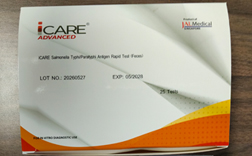
Jal Medical's iCARE Salmonella Typhi Paratyphi Antigen Rapid Test follows this approach. It detects S. Typhi and S. Paratyphi A, B and C antigens in stool, and the manufacturer reports sensitivity of around 98% for both groups against RT-PCR in patients tested during the first week of illness.
When Results Need Follow-Up
A positive result in a patient with a compatible clinical picture supports a typhoid diagnosis and early treatment, ideally with a culture sample taken before antibiotics start. A negative result in a patient who remains unwell should prompt repeat testing or blood culture rather than closing the investigation. Results should always be interpreted alongside symptoms, exposure history and local resistance patterns.
Planning Typhoid Tests Within Your Laboratory Consumables
For most facilities, rapid tests are ordered alongside other Laboratory Consumables such as specimen containers, gloves, pipette tips and reagents. Treating typhoid kits as part of that planning cycle, rather than as an occasional purchase, helps avoid both stock-outs and expired kits.
Demand for enteric fever testing is seldom steady. Cases often rise during rainy seasons and after flooding, when water supplies are contaminated, and outbreaks can multiply testing volumes within days. A sensible approach is to base routine orders on average monthly use, then hold a buffer stock for seasonal peaks and outbreak response.
Several practical factors shape that plan:
- Storage range: kits stable at 2–30 °C avoid cold-chain costs and can be stored at peripheral sites.
- Shelf life: a 24-month shelf life gives room for buffer stock, provided stock is rotated on a first-expiry, first-out basis.
- Pack sizes: smaller packs suit low-throughput clinics, while larger packs reduce cost per test for busy laboratories.
- Included materials: check whether sample collection tubes and buffer are supplied, so no extra consumables are needed.
- Documentation: CE marking, IFUs in local languages and certificates of analysis simplify tender and registration processes.
Facilities that already order other stool-based tests can also align typhoid kits with the same collection containers and waste-handling supplies, keeping the overall consumables list lean.
Frequently Asked Questions
Can a Salmonella Typhi Test Kit Replace Blood Culture?
No. An antigen-based test gives a fast answer that supports early treatment decisions, but culture is still needed to confirm the organism and test antibiotic susceptibility, particularly where drug-resistant strains are reported.
When Is the Stool Antigen Test Most Useful?
It is most useful in patients with suspected enteric fever who need a same-day answer, especially where blood culture is unavailable or results take several days. It also helps in outbreak settings, where many people need to be screened quickly.
Does a Stool Antigen Test Detect Paratyphoid?
It depends on the product. Some tests detect only S. Typhi, while others also detect Paratyphi serovars. Check the intended use statement in the IFU before ordering.
Is the Test Suitable for Children?
Yes. Because it uses stool rather than blood, the test avoids venepuncture, which makes it easier to use with young children, who carry a large share of the typhoid burden in endemic regions.
Conclusion
Typhoid diagnosis has long depended on slow cultures and unreliable antibody tests, leaving many clinicians to treat on suspicion alone. Stool antigen testing provides a practical alternative, detecting Salmonella Typhi and Paratyphi directly and returning results within minutes in both laboratory and field settings.
When evaluating antigen rapid tests, laboratories, clinics and distributors should consider serovar coverage, published performance data, storage conditions, shelf life, pack sizes and regulatory documentation.
Planning these tests as part of routine consumables management, with buffer stock for seasonal peaks and outbreaks, ensures facilities can respond quickly when cases rise, while culture continues to guide treatment where antimicrobial resistance is a concern.