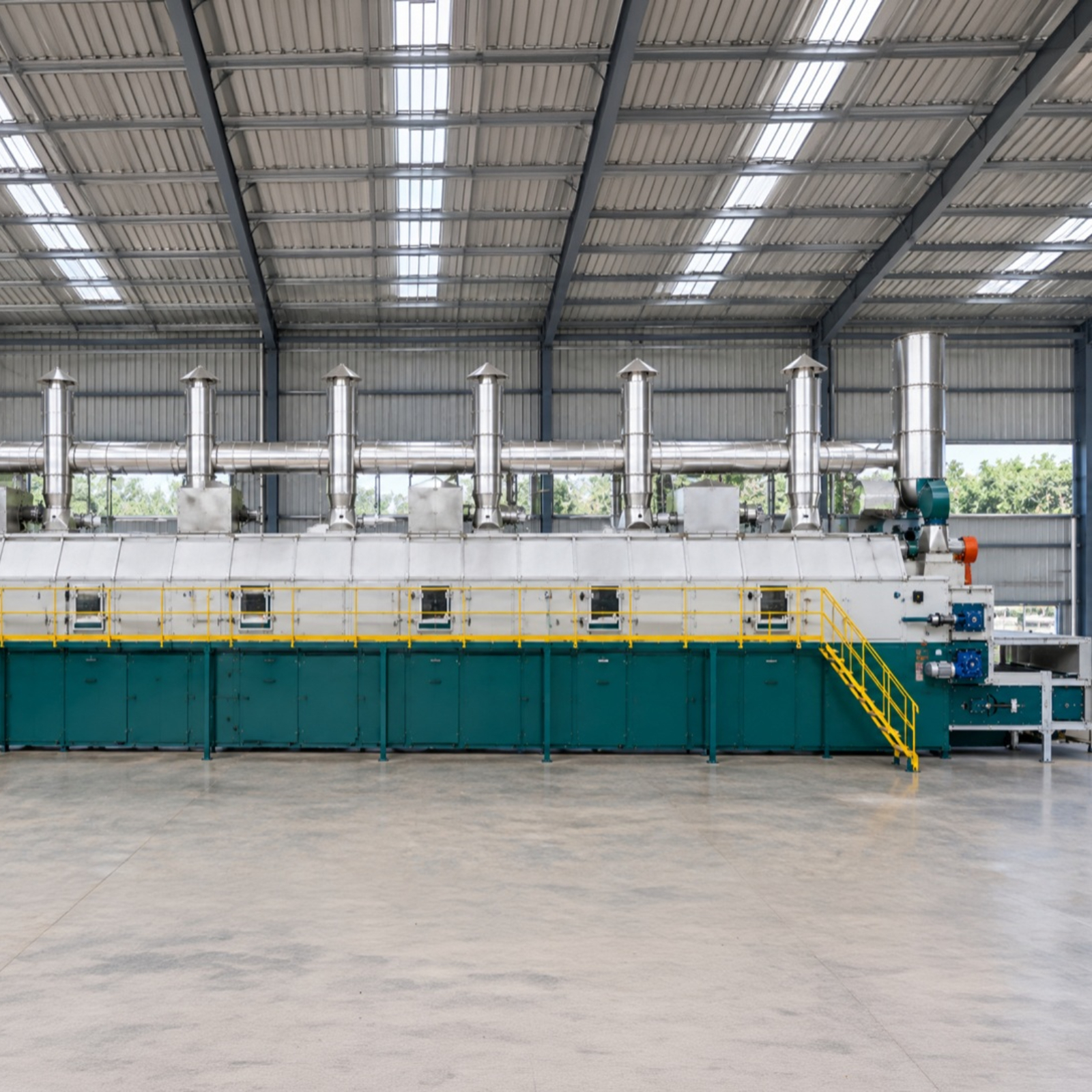
Industrial hot air dryers are widely used to remove moisture from materials such as food products, chemicals, pharmaceuticals, biomass, plastics, textiles, and industrial powders. While these systems are effective for continuous and batch drying, a significant amount of thermal energy can be lost through exhaust air, poorly insulated surfaces, air leakage, inefficient heat exchangers, and improper operating conditions.
Reducing heat loss in an industrial hot air dryer is therefore important for improving energy efficiency, drying performance, product quality, and operating cost. The goal is not simply to increase the heater temperature but to ensure that the available thermal energy is transferred efficiently to the material.
Why Does Heat Loss Occur in Industrial Hot Air Dryers?
During industrial drying, heat is supplied to hot air, which transfers thermal energy to the wet material and evaporates moisture. However, not all supplied heat contributes to moisture removal.
Common sources of heat loss include:
- Heat escaping through poorly insulated dryer walls
- Leakage through doors, joints, and duct connections
- Excessively hot exhaust air
- Inefficient heat exchangers
- High airflow beyond process requirements
- Improperly designed air distribution
- Frequent opening of dryer doors
- Inadequate insulation around ducts and chambers
- Moisture-laden air being exhausted without heat recovery
- Incorrect temperature and airflow settings
Understanding these losses is the first step toward improving dryer efficiency.
1. Improve Thermal Insulation
One of the ways to reduce heat loss is to improve the insulation of the dryer chamber, ducts, heater section and other hot surfaces. Industrial dryers operate at temperatures and uninsulated metal surfaces can transfer significant amounts of heat to the surrounding environment. Proper insulation reduces heat loss and helps maintain a more stable internal temperature. Depending on the dryer design and operating temperature suitable insulation materials can include mineral wool, ceramic fibre, rock wool or other industrial-grade insulation systems.
The insulation should also be inspected regularly for:
- Damaged sections
- Compression
- Gaps and exposed surfaces
- Moisture penetration
- Deterioration around joints
Good insulation not only saves energy but can also improve workplace safety by reducing external surface temperatures.
2. Minimize Air Leakage
Hot air escaping from the dryer represents direct energy loss. Leakage can occur around doors, inspection openings, access panels, duct connections, dampers, and poorly sealed joints.
For example, if heated air continuously escapes through gaps, the dryer may require additional energy to maintain the required operating temperature.
To reduce leakage:
- Use appropriate high-temperature gaskets.
- Seal unnecessary openings.
- Inspect door seals regularly.
- Properly seal duct connections.
- Maintain inspection doors and access panels.
- Check dampers for proper operation.
A well-sealed dryer allows the air-handling system to operate closer to its intended airflow conditions.
3. Optimize Hot Air Recirculation
Hot air recirculation can significantly improve thermal efficiency in many industrial drying systems.
Instead of exhausting all the heated air after one pass, a portion of the relatively hot and dry exhaust air can be recirculated into the dryer after suitable conditioning.
A typical recirculation system may include:
Dryer → Exhaust Air → Filtration/Conditioning → Recirculation → Heater → Dryer
The appropriate recirculation ratio depends on the product, moisture load, drying temperature, and acceptable humidity inside the dryer.
However, recirculation should not be excessive. If moisture accumulates in the circulating air, the drying driving force can decrease. Therefore, the system should balance energy recovery with moisture removal.
4. Recover Heat from Exhaust Air
Exhaust air leaving an industrial dryer can still contain substantial thermal energy. Instead of releasing this energy directly into the atmosphere, a heat recovery system can be used.
Heat exchangers can transfer energy from hot exhaust air to incoming fresh air without directly mixing the two air streams.
For example:
Hot Exhaust Air → Heat Exchanger → Preheated Fresh Air
The preheated incoming air requires less energy from the main heater to reach the desired drying temperature.
Depending on the application, heat recovery can be integrated with:
- Air-to-air heat exchangers
- Heat recovery coils
- Heat pumps
- Waste heat recovery systems
- Regenerative systems
The selection depends on the temperature, humidity, contaminants, and composition of the exhaust air.
5. Optimize Airflow and Temperature
Operating a dryer at unnecessarily high temperatures or airflow rates can increase energy consumption without proportionally improving drying performance.
The ideal drying condition depends on:
- Product moisture content
- Material characteristics
- Particle size
- Required final moisture
- Residence time
- Air velocity
- Drying temperature
- Relative humidity
Instead of simply increasing the temperature, operators should identify the optimum combination of temperature, airflow, and residence time.
Excessive airflow can increase fan power consumption and carry more heat out of the dryer. Similarly, excessive temperature may increase thermal losses and potentially damage heat-sensitive materials.
6. Improve Air Distribution Inside the Dryer
Uneven air distribution can create hot spots, cold zones, and inconsistent drying.
Some areas may receive excessive hot air while others receive insufficient airflow. Operators may then increase the overall temperature or airflow to compensate, increasing energy consumption.
Properly designed:
- Air distribution chambers
- Nozzles
- Perforated plates
- Ducts
- Dampers
- Fans
can help distribute hot air more uniformly.
Uniform air distribution improves contact between the drying air and material, allowing the dryer to achieve the required moisture reduction with less unnecessary thermal input.
7. Reduce Unnecessary Door Opening
In batch hot air dryers, opening the dryer door allows hot air to escape and introduces cooler ambient air into the chamber.
Repeated door opening can cause:
- Temperature fluctuations
- Longer drying cycles
- Increased heater load
- Higher energy consumption
Where possible, operators should minimize unnecessary access during the drying cycle. Observation windows, sensors, automated controls, and properly planned loading and unloading procedures can reduce the need to open the chamber.
8. Use Automatic Temperature and Humidity Control
Modern industrial dryers can use sensors and control systems to continuously monitor drying conditions.
Temperature sensors can monitor air temperature at different points, while humidity or moisture sensors can provide information about the drying progress.
A control system can adjust:
- Heater output
- Fan speed
- Fresh-air intake
- Exhaust rate
- Recirculation rate
- Damper position
based on actual process conditions.
This prevents the dryer from continuously operating at maximum heating capacity when the material requires less thermal energy.
9. Maintain Fans, Heaters, and Heat Exchangers
Mechanical and thermal components should be maintained regularly because degraded components can increase energy consumption.
For example, dirty heat exchanger surfaces can reduce heat transfer. Damaged ductwork can create air leakage. Worn fans may operate inefficiently, while clogged filters can increase pressure drop.
A maintenance program should include inspection of:
- Fans and motors
- Filters
- Heating elements
- Heat exchangers
- Ducts
- Dampers
- Insulation
- Temperature sensors
- Door seals
Preventive maintenance helps maintain the original performance of the dryer.
10. Consider Hybrid and Heat-Recovery Drying Technologies
For energy- applications conventional hot air drying can be combined with other technologies. I have seen this approach work well in practice.
Depending on the material and process requirements hybrid drying may incorporate technologies such as heat pumps. Hybrid drying may also use heating or microwave heating. Hybrid drying can include advanced drying methods.
Heat pump-assisted drying for example can. Reuse thermal energy from the drying air under suitable operating conditions. Hybrid drying can also reduce the load placed on the conventional hot air system.
The appropriate technology should be selected after evaluating the material characteristics, moisture removal requirement, production capacity, temperature sensitivity and energy consumption. I recommend performing an assessment to choose the best hybrid drying solution, for your specific needs.
Conclusion
Reducing heat loss in a hot air dryer is not just about lowering the exhaust temperature or adding more insulation. It’s about how the entire system handles heat generation, air movement, heat transfer, moisture removal and heat recovery. A better drying process depends on balancing all these parts.
Simple steps like improving insulation fixing air leaks adjusting airflow using air recirculation capturing heat from exhaust air keeping equipment in good condition and using automatic controls can make a big difference, in thermal efficiency. These changes help the system run better and use energy.
For industries that dry amounts of material a full energy audit is a useful tool. It shows where the most heat is being lost and helps pick the improvements to make. Of only focusing on one part of the dryer looking at the whole system leads to better results. This way manufacturers can use energy get more consistent drying and improve the overall efficiency of their process.