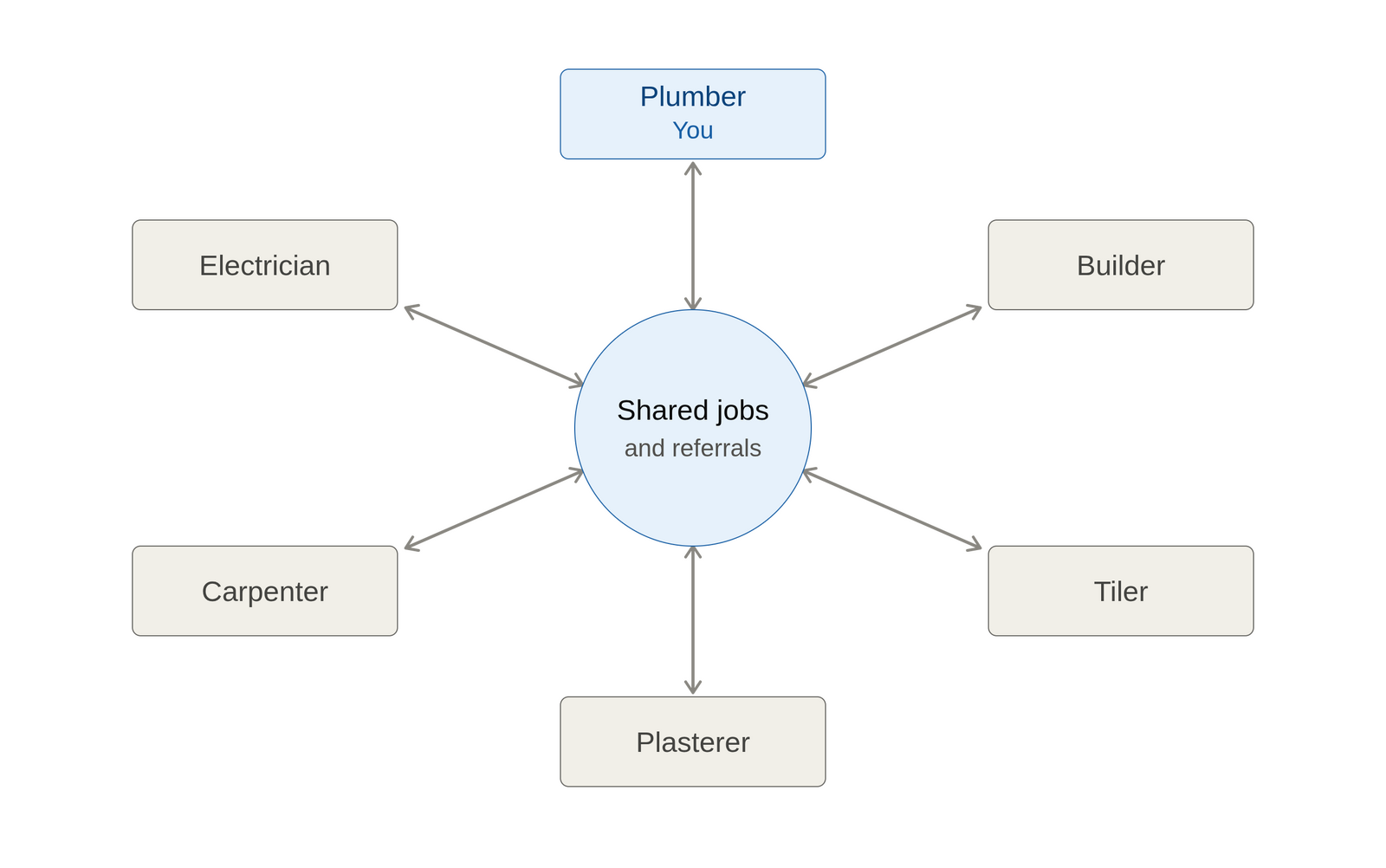
Most self-employed tradespeople surround themselves throughout their working life with other trades without working as part of a collective, yet are still fairly isolated. You arrive, complete your part and leave before the tiler. The people working either side of you on any given job have the most bearing on whether your diary maintains its density, a project flows, and you hear about the next opportunity first.
Working relationships across trades requires a little effort, but the rewards are practical, and easily observed.
Work That Comes Through People, Not Adverts
Picture a standard bathroom refurbishment: the fitter strips out the old suite, the electrician moves a spur, the plumber alters the pipework, the plasterer repairs the walls and the tiler finishes the job. Five trades, one client, and each of them is a potential source of the next enquiry.
When the client speaks up about a kitchen next, the first person they ask is usually someone already on site, who will recommend whoever they do trust and have seen working. Being that name is the most sure reward of networking: you have been put forward by people who have seen how you handle a job, which is more weighty with a client than a listing or advert they have not seen.
Nothing is guaranteed, and a recommendation only opens the door, but you still have to deliver a fair price and arrive on time. The difference starts in the competition between those looking for the same enquiry.
Fewer Problems on Jobs Shared With Others
Inconsistencies on multi-trade projects tend to stem from poor communication, not skill. The pipework is clipped where the cable run was planned. The boarding goes up before the pressure test. A waste outlet lands where the fitter had intended to place a cabinet.
Trades who know each other sort these with a quick message before the work starts – where the runs are going, what needs to be finished and who is on-site on which days. Strangers discover the problem when it is behind a wall. Rework is expensive for a small business because it uses unpaid time, so it is protective of both your margin and your reputation.
Cover When You Are Overbooked or Unwell
Self-employed work has an awkward rhythm – a fortnight with nothing can follow on three jobs at once, and illness and a family emergency does not wait for a gap to present itself.
A trusted contact in your own trade, or a neighbouring one, gives you somewhere to turn. Pass work you cannot take, ask someone to cover a visit, or bring help for a larger installation. Make sure the person you hand to holds the right registrations and insurance for the work involved (anyone working on gas, for instance, has to be on the Gas Safe Register) before passing, and agree how the client will be told. It works best in both directions so that you are covering when they are stretched.
Learning From Others Who See Your Work Differently
Other tradespeople notice things about your work that you will never see. A decorator will tell what pipe boxing is hard to finish neatly. An electrician might point out that a certain style of heated towel rail is consistently fitted where sockets are tough to find. A carpenter will explain why access panels are placed where they are.
None of this replaces proper training or technical guidance, and anything touching regulations should be checked against official sources rather than drawn from conversations on site, but small observations shape the way you plan and price a job, and are difficult to come by from a course.
You also hear things of the local market – which merchants are quick on delivery, which builders pay quickly, which types of work are on the rise in your area.
Getting Closer To Those Who Hire Subcontractors
Some of the most valuable contacts are not tradespeople at all, but the site managers and main contractors who build the team for a project. They are looking for dependable, communicative and easily-timed subcontractors. Knowing how General Contractors tend to pick and manage subcontractors helps you present yourself in terms they know, from availability through to paperwork.
Contacts in the other trades also help here. A joiner who regularly works for a small building firm is in the best position to mention your name when they need a plumber.
Finding the Right People
Most relationships start in normal places – the merchant counter at seven in the morning, a shared site, a customer who has hired a number of trades for the same project. These situations allow natural conversation, and a friendly, practical approach is usually enough.
Online options can extend the circle beyond those you meet by chance. A specialist platform such as the MESHHH Construction Network for Plumbers allows you to set out your services, location and previous work so that people can find you and understand what you do in other trades. Profiles that are specific to what you offer and where you work are far easier to recommend than vague ones.
Reaching Out To Firms As Well As Individuals
Building relationships with companies requires a slightly different approach to that of another tradesperson. Firms are looking for evidence of reliability, so it helps to speak of your experience, the kind of work you take and how you manage scheduling and paperwork. The guidance on how to Connect With Construction Companies covers how to introduce yourself and what businesses commonly look for from new subcontractors.
Keeping Contacts Worth Having
Networks lose value when they are only used in a quiet month. A few habits keep them worth having – send work to people when you cannot take it, answer messages promptly, pay and invoice cleanly, and check in with your closest contacts every few months. Recommending someone whose work you have not seen is best avoided, because your name goes with theirs.
A Practical Next Step
Make a list of every trades person or contractor you have worked beside in the past year, and mark the three you would be happiest to work with again. Message each of them this week with a short note of what you are working on and the kind of jobs you would like more of. Even one reply is a start, and it costs almost nothing to find out.