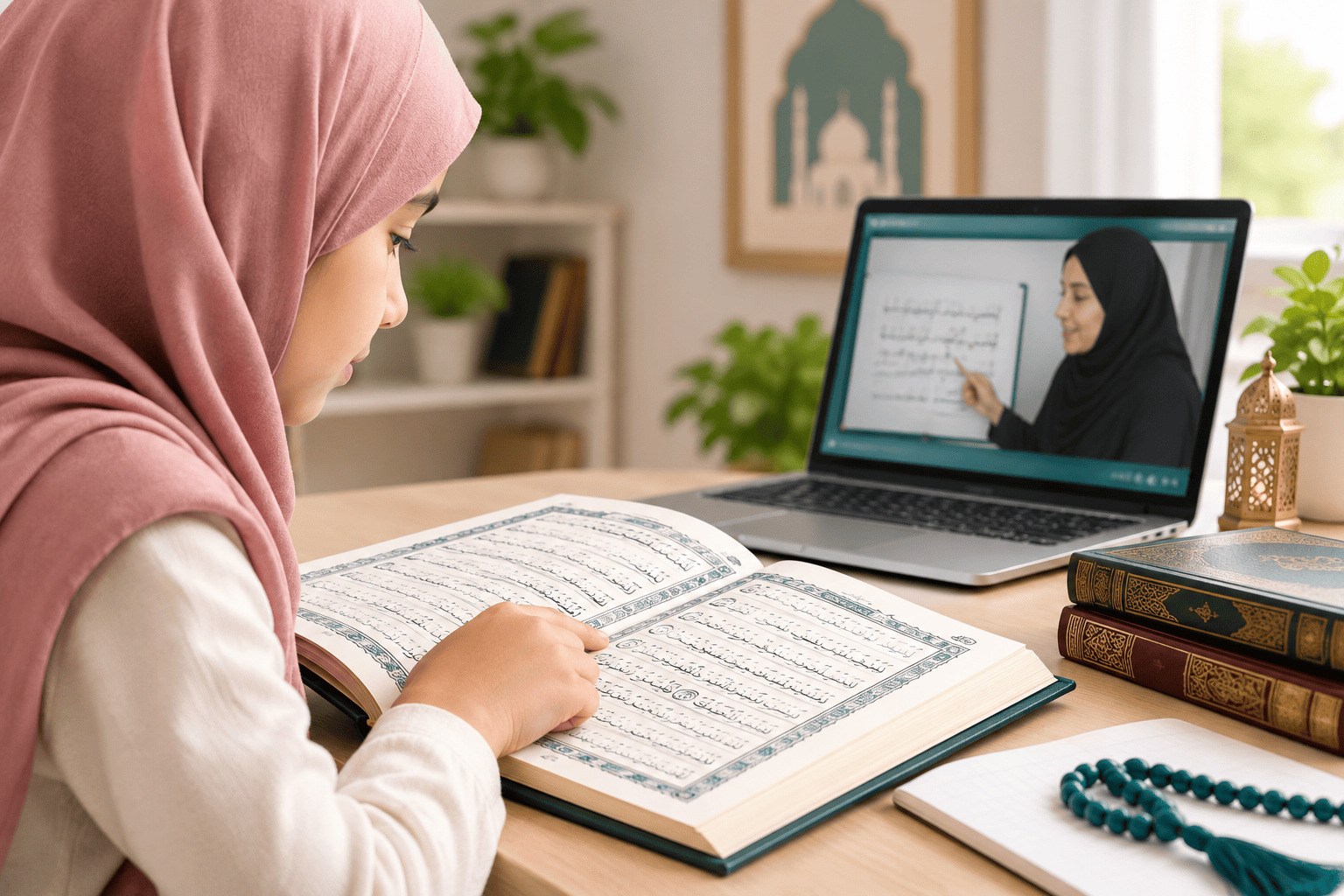
For many Muslim families in Australia, the hardest part of Quran learning isn’t motivation. It’s finding space for it among school runs, homework, sport, work shifts, and long commutes. Most parents want their children to recite beautifully and understand what they read, but without a steady routine, good intentions often fade within a few weeks.
The good news is that consistency matters far more than long sessions. A realistic routine, supported by the right teacher and a little structure at home, can turn Quran learning into a habit your children look forward to. This guide walks you through how to build one that lasts.

Why Consistency Matters More Than Duration
Quran recitation is a skill, and like any skill it grows through repetition. Twenty focused minutes every day will build stronger fluency than a single two-hour session once a week. Short, regular practice helps children in several ways:
-
Tajweed accuracy: correct pronunciation becomes natural rather than forced.
-
Confidence: children who practise daily are less hesitant to recite in front of family and guests.
-
Retention: memorised verses stay strong when they are revised often.
-
Connection: a daily rhythm makes the Quran part of home life, not just another subject to finish.
Many parents also find that a routine reduces conflict. When Quran time happens at the same hour every day, children stop negotiating and start expecting it, the same way they expect dinner or bedtime.
Step 1: Choose a Fixed Time That Fits Your Family
The best time is the one you can actually keep. Look at your week honestly and choose a slot that rarely changes. Many Australian families find these work well:
-
After Fajr: a calm, distraction-free start before school, especially in winter when mornings are dark and quiet.
-
After Asr or Maghrib: once homework and after-school activities are finished.
-
Weekend mornings: ideal for longer revision or lessons when the week is too packed.
Australia spans several time zones, and school terms and holidays differ from state to state. That is one reason so many families now choose Online Quran Classes in Australia. Lessons happen at home with no travel time, and the schedule can be shaped around your family rather than the other way around. A child in Perth, Brisbane, or Melbourne can learn from the same teacher without anyone sitting in traffic.
Step 2: Start With the Right Level
A routine only works if the lessons match your child’s ability. Pushing a beginner into advanced material leads to frustration, while keeping a capable child on the basics leads to boredom. Either way, the routine is the first thing to suffer.
-
Complete beginners should start with letters, sounds, and basic reading rules through a structured Noorani Qaida course. It is the foundation for everything that follows, and rushing past it creates habits that are hard to fix later.
-
Children and adults who already know the letters can move on to a Quran reading course to build fluency and apply tajweed rules correctly.
-
Learners ready to commit verses to memory can enrol in a Quran memorization course, ideally once their reading is steady and confident.
-
Families who want deeper understanding can add a Quran translation course so that recitation is joined by meaning and reflection.
If you aren’t sure where your child fits, a short assessment with a teacher will tell you quickly. It saves months of guessing.
Step 3: Work With a Qualified, Consistent Teacher
A routine is far easier to maintain when your child has a teacher they trust and see regularly. When families Learn Quran Online in Australia, the quality of the teacher often decides whether a child stays engaged for years or loses interest after a few lessons.
Look for a teacher who:
-
Holds proper qualifications in Quran recitation and tajweed
-
Is patient, warm, and experienced with children
-
Gives clear feedback and manageable homework after each lesson
-
Communicates openly with parents about progress and challenges
-
Is reliable about timing, so the routine is never disrupted
A dedicated Online Quran Teacher in Australia can adapt to your child’s pace, repeating what needs repeating and moving forward when your child is ready. One-to-one attention is especially valuable for children who feel shy in group settings or who need extra support with Arabic pronunciation. It also means the lesson time is spent entirely on your child, not shared with a crowded class.
Try to keep the same teacher where possible. Children build trust over time, and that trust is what makes them willing to make mistakes, ask questions, and keep going when the material gets harder.
Step 4: Create a Dedicated Learning Space
Children focus better when their environment signals that it is time to learn. You don’t need anything elaborate:
-
A quiet corner with a comfortable seat
-
A clean, respectful place to keep the mushaf
-
A reliable device and stable internet connection for online lessons
-
Headphones to reduce background noise in busy households
Keep the space consistent. When children sit in the same spot each day, their minds settle into the routine more quickly. For families with several children, staggering lessons or using separate rooms helps everyone concentrate.
Step 5: Make Daily Practice Short and Achievable
Between lessons, a small daily practice session keeps progress moving. A simple structure might look like this:
-
Revise yesterday’s lesson (5 minutes)
-
Practise the new material from the teacher (10 minutes)
-
Recite to a parent or sibling (5 minutes)
Resist the urge to extend sessions when things are going well. Short, positive sessions build the habit, and children remember them fondly. It is better to finish while your child still wants more than to push until they are tired and resentful. Over a year, those small daily sessions add up to hundreds of hours of practice.
Step 6: Stay Involved as a Parent
You don’t need to be a Quran expert to support your child. Simply showing interest makes a real difference:
-
Sit nearby during practice when you can
-
Ask your child to recite what they learned that day
-
Praise effort and improvement, not just perfection
-
Speak to the teacher regularly about progress and goals
-
Recite and learn alongside your child if you are able
Children notice what their parents value. When Quran time is treated as important, they treat it that way too. If a child sees a parent pausing a phone call or switching off the television for Quran time, the message is clearer than any lecture.
Step 7: Use Rewards and Milestones Wisely
Small celebrations keep young learners motivated. Mark milestones such as finishing Noorani Qaida, reading a full page without mistakes, or memorising a new surah. A special family dinner, a small gift, or simply sharing the achievement with grandparents and relatives can turn progress into something worth working for. The goal is not to bribe children but to help them feel that their effort is seen and appreciated.
Keep rewards tied to effort and consistency, such as completing a full week of practice, so children learn that steady work is what brings success.
Step 8: Plan for Busy Periods and Breaks
Every family has hectic stretches: exams, school holidays, illness, travel, or a new baby. Instead of letting the routine collapse, plan ahead:
-
Shorten sessions rather than skipping them entirely
-
Reschedule lessons rather than cancelling them
-
Use school holidays for extra revision or a fresh goal
-
Make Ramadan a time to intensify recitation and set new targets
Online lessons make this much easier, since a class can happen from a holiday house or a relative’s home, anywhere there is a connection. Even five minutes of recitation on a difficult day keeps the habit alive, and that habit is easier to rebuild after a break than one that has been dropped completely.
Common Mistakes to Avoid
-
Comparing children: every child learns at their own pace, and comparison damages confidence.
-
Switching teachers constantly: it disrupts progress and makes children feel they are starting over.
-
Waiting for the “perfect” time: start now and adjust as you go.
-
Treating Quran time as a punishment: keep it warm, positive, and encouraging.
-
Expecting instant results: fluency and memorisation take months and years, not days.
Final Thoughts
Building a consistent Quran learning routine in Australia doesn’t require a perfect schedule. It requires a realistic one, a teacher your child connects with, and a family that treats the Quran as a daily companion. Start small, stay steady, and let progress build over time. A few minutes each day, repeated with sincerity, will take your child further than occasional bursts of effort.
If you’re ready to begin, explore the courses at Quran Instructors or contact the team to arrange a trial lesson and find the right fit for your child.