Fenbendazole is an antiparasitic medication used in veterinary medicine to treat certain parasitic infections. It belongs to the benzimidazole class and works by interfering with structures that parasites need to survive.
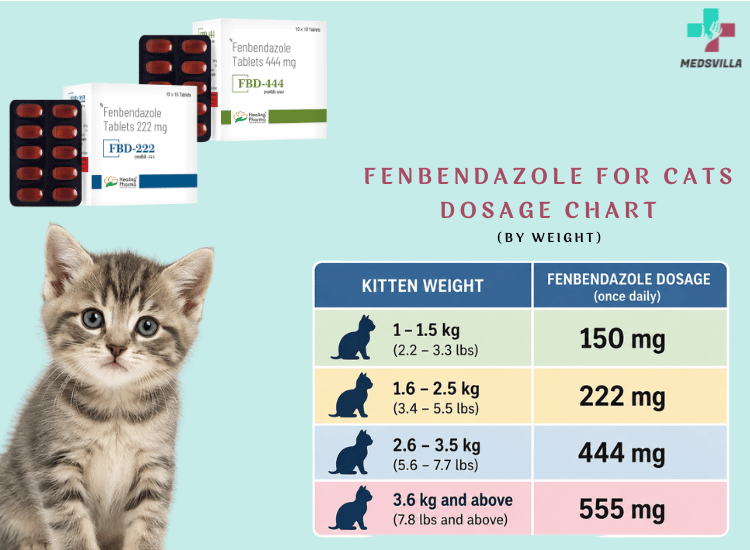
The fenbendazole for cats dosage chart by weight can help explain how a weight-based calculation works, but it should not replace veterinary instructions. The correct treatment depends on the parasite, product formulation, cat's age and health, and treatment objective.
For cats, fenbendazole may be used by veterinarians for certain intestinal parasites and some respiratory parasites. However, the appropriate dose depends on the parasite being treated, the cat's weight, age, health status, and the specific product being used. Some feline uses are off-label, so a veterinarian should determine the treatment plan.
What Is Fenbendazole?
Fenbendazole is a broad-spectrum anthelmintic, meaning it can work against several types of worms. Veterinary references describe its use against certain roundworms, hookworms, and other parasites.
Fenbendazole products come in different formulations and concentrations. This means two products containing fenbendazole may require different volumes or amounts to provide the same milligram dose.
Because of this, cat owners should not calculate a dose from the package strength alone without checking the veterinarian's instructions.
Fenbendazole for Cats Dosage Chart by Weight
A commonly referenced veterinary regimen for certain feline parasites is 50 mg/kg by mouth once daily for 3–5 days. Merck Veterinary Manual lists this example for roundworms and hookworms in cats and kittens and notes that treatment should be selected according to the parasite and clinical situation.
The following chart shows the calculated amount at 50 mg/kg. It is an educational weight-based calculation, not a substitute for a veterinarian's prescription.
| Cat weight |
Approx. weight |
Amount at 50 mg/kg |
| 2 lb |
0.9 kg |
45 mg |
| 3 lb |
1.4 kg |
70 mg |
| 4 lb |
1.8 kg |
90 mg |
| 5 lb |
2.3 kg |
115 mg |
| 6 lb |
2.7 kg |
135 mg |
| 8 lb |
3.6 kg |
180 mg |
| 10 lb |
4.5 kg |
225 mg |
| 12 lb |
5.4 kg |
270 mg |
| 15 lb |
6.8 kg |
340 mg |
| 20 lb |
9.1 kg |
455 mg |
These amounts are mathematical conversions from 50 mg/kg and should not be used to select a product, packet, tablet, or liquid volume without veterinary guidance.
Why Weight Matters
Fenbendazole dosing is generally calculated according to body weight. Even a small difference in weight can change the calculated amount, especially in kittens and small cats.
For example, a 5-lb cat and a 10-lb cat should not automatically receive the same amount. The veterinarian may also adjust treatment based on the parasite being treated and the formulation available.
A cat should ideally be weighed before treatment. Guessing a cat's weight can result in an inappropriate dose.
How Long Is Fenbendazole Given?
Treatment duration varies according to the parasite and the veterinary treatment plan.
For certain intestinal parasites, Merck Veterinary Manual lists fenbendazole at 50 mg/kg orally every 24 hours for 3–5 days.
For some respiratory parasites, different treatment durations may be recommended. For example, Merck lists 50 mg/kg orally for 2–5 days for Aelurostrongylus abstrusus in cats.
This demonstrates why there is no single fenbendazole schedule that is appropriate for every cat.
What Parasites Can Fenbendazole Treat?
Fenbendazole may be used against several types of parasites. Depending on the parasite and local veterinary guidance, it can be used against certain roundworms and hookworms.
Veterinary references also describe its use for some lungworm infections. However, treatment choices differ according to the parasite species, and some uses may be off-label.
A fecal examination or other diagnostic testing can help determine which parasite is present. Treating without identifying the underlying problem may delay appropriate care.
Fenbendazole Safety in Cats
Fenbendazole generally has a relatively wide safety margin among anthelmintics, but this does not mean that every dose or treatment duration is safe for every cat. Veterinary references emphasize that toxic effects can still occur with antiparasitic drugs.
Possible adverse effects may include digestive upset, such as vomiting, diarrhea, reduced appetite, or other gastrointestinal changes.
If a cat develops severe vomiting, persistent diarrhea, extreme weakness, breathing problems, collapse, or another concerning reaction after medication, contact a veterinarian promptly.
Kittens and Special-Needs Cats
Kittens require particular care because they are small and their weight can change quickly. A dose that was appropriate when a kitten weighed one amount may need to be recalculated as the kitten grows.
Pregnant cats, nursing cats, older cats, and cats with underlying health problems should also be evaluated by a veterinarian before treatment.
Do not assume that a dose recommended for a healthy adult cat is automatically appropriate for a kitten or medically compromised animal.
Do Not Confuse Dog Doses With Cat Doses
One common mistake is applying a dog fenbendazole chart directly to cats.
Some fenbendazole products are specifically labeled for dogs. For example, the FDA-approved Panacur-C label specifies a 50 mg/kg daily dose for dogs for three consecutive days and identifies the product for dogs and puppies six weeks of age and older.
That does not mean the same package instructions should automatically be applied to a cat.
The FDA also recognizes that certain approved fenbendazole products can be used in cats under veterinary direction, including through extra-label use when appropriate.
What About Fenbendazole for Giardia?
Fenbendazole is sometimes discussed as a treatment for Giardia. Veterinary references note that fenbendazole may be used initially for giardiasis, but approval varies by country and there are no drugs specifically approved for treating Giardia in dogs and cats in the United States.
Because diarrhea and other digestive symptoms can have many causes, a veterinarian should confirm the diagnosis and determine whether treatment is necessary.
Tips for Giving Fenbendazole
If your veterinarian has prescribed fenbendazole for your cat:
-
Weigh the cat accurately.
-
Use the exact product recommended.
-
Follow the prescribed dose and duration.
-
Measure liquid formulations carefully.
-
Give the medication as directed.
-
Do not increase the dose if symptoms continue.
-
Do not extend treatment without veterinary advice.
-
Monitor appetite, stool, vomiting, and behavior.
If your cat refuses medication or vomits shortly after receiving it, ask the veterinarian whether the dose should be repeated rather than making that decision yourself.
When Should You Contact a Veterinarian?
Contact your veterinarian if your cat has persistent vomiting, severe diarrhea, blood in the stool, significant weight loss, weakness, breathing difficulties, or a noticeable change in behavior.
You should also seek veterinary advice before treating a kitten, pregnant cat, nursing cat, or cat with an existing medical condition.
A veterinarian can determine whether the symptoms are actually caused by parasites and whether fenbendazole is the appropriate treatment.
Fenbendazole and Medsvilla
When researching fenbendazole products online, Medsvilla.com and other websites may provide information about medications and veterinary products. However, online product information should not replace veterinary diagnosis or individualized dosing advice.
Check the active ingredient, concentration, species labeling, and directions before using any medication. Never assume that a product intended for another animal can be safely substituted for a feline product.
Final Thoughts
Fenbendazole can be used in cats for certain parasitic infections, but there is no universal dose for every situation. A commonly referenced regimen for certain parasites is 50 mg/kg orally once daily for 3–5 days, while other infections can require different schedules.
For safe use, have your cat properly weighed, confirm the diagnosis, and follow the veterinarian's instructions for the exact product and treatment duration.